Up next · Episode Two
This film couldn’t be loaded. Check your connection and reload the page.
If it still won’t play, try a current version of Safari, Chrome, Edge or Firefox.
Episode One of Three
10:02English captionsThe Reader
Splintery pews, a single Scofield Bible and a brother nearly lost at the Mexican border. A literature student becomes a crime novelist with a typographer's eye, and asks why the Bible is printed like a telephone directory.
Chapters
TranscriptSelect a time to play from there
Cold open
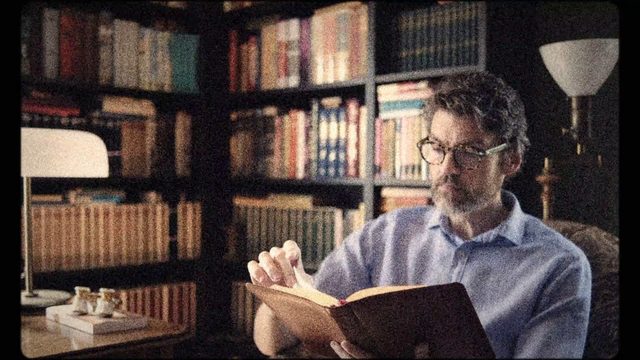
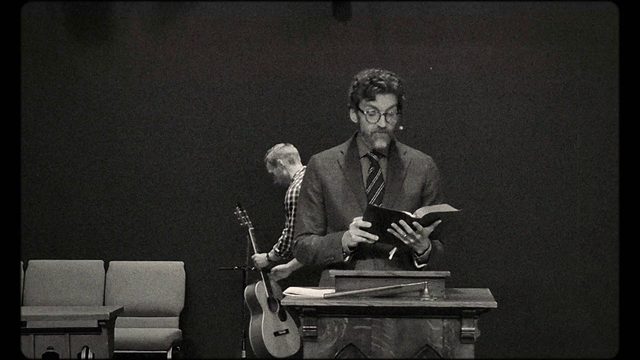
J. Mark BertrandNow, the first time I heard this story, I was a very young boy in church. I remember sitting on wooden pews. Not only were the pews wooden when I was a boy, but they were splintery as well. So it was really torment to sit through some of those sermons, in a way that none of you can relate to.
But occasionally, the pastor would talk about something that would make my ears perk up. Occasionally the Bible would have something that I'm like, wait a second, I need to hear this.
NarratorHe grew up with one Bible, a gift, in a Baptist church where everybody carried a Scofield.
It did not occur to him, until his early twenties, that he could buy another.
He would spend the rest of his life asking what a Bible should look like, if it were meant to be read.
Act One: A Man of Letters
NarratorJ. Mark Bertrand calls himself a Southern ex-pat. He was raised on the King James Version, in a church that revered its translators as saints.
J. Mark BertrandI grew up as a Baptist.
NarratorThe sermons ran long. The maps in the back of the Bible helped. So did daydreams about Alexander the Great.
J. Mark BertrandI remember the first time I heard this story in church. I was a pretty young adolescent male, and I, like others in this room, was down for any kind of violence the Bible was willing to provide.
NarratorThere was also a brother, whom he calls by another name.
J. Mark BertrandMy older brother's name, as some of you know, is Stephen, but I like to call him Esteban. I do it to lovingly remind him that he was this close to growing up in Mexico and speaking Spanish for the rest of his life.
NarratorOn a family day trip across the Mexican border, the brother was still small enough to ride in a stroller.
J. Mark BertrandSome young men came to my mother and offered to help her by carrying the stroller down the steps. But when they reached the foot of the steps, they took off running with my brother in his stroller.
And you can imagine my mom's reaction. She started screaming. She was yelling really loudly, chasing after the kidnappers, and causing quite a stir.
And so they ran and abandoned my brother, and he was rescued.
What I remember about that moment, though, is how embarrassing it was, because my mother made a lot of noise.
She had me. She could have let him go. Things might have been better. Esteban would have been happy, I'm sure, in this other life that he might have lived.
NarratorAt Union University, he studied English literature.
J. Mark BertrandThere's a certain kind of story that I have always been obsessed with, and they all have one thing in common, which is that the main characters in the story go on a journey, and the journey ends with madness. I don't know what it says about me that I'm attracted to stories like that.
Bertrand Russell, no relation, by the way.
And when I was in college, I bought the book, kept it on my shelf, and did not read it, out of fear that as I read the book, I too would become not a Christian, that I would be overwhelmed by his arguments. Eventually, I read the book, and as you can see, it did not have that effect.
NarratorThen came the University of Houston, and a Master of Fine Arts in creative writing.
He became a novelist.
J. Mark BertrandThree, four novels that have been published, and others that have not yet been published, and at least one that will never be published. Maybe more than one.
NarratorHis crime novels would follow a Houston homicide detective named Roland March, through three books. One critic called him a major crime fiction talent.
J. Mark BertrandI've written crime novels, and in my crime novels I've tried to tell the truth about the world, but it's not the whole truth.
I've chosen certain aspects of the world to really engage with, and I've come at them with Christian ideas in mind.
And I often say, you will meet a lot more people who want to be writers than people who want to write.
NarratorAnd there was a third vocation, the one that would matter most. He was a typographer.
Years later, the designers of his novels would receive his proofs marked up by hand. Make all capitals small capitals, he wrote, citing Robert Bringhurst.
Act Two: The Problem on the Page
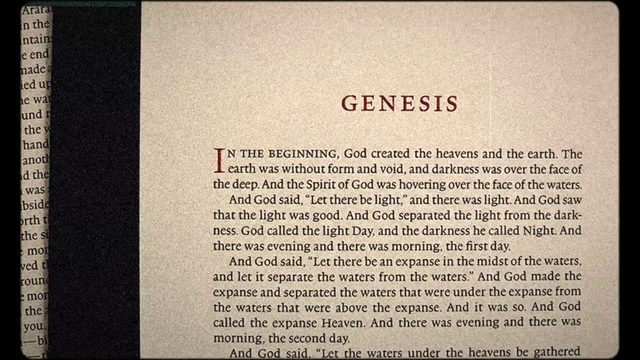
NarratorFor much of its history in English, the Bible was printed like any other book.
In 1560, the Geneva Bible gave every verse a number, and set each one apart.
The King James Version of 1611 did the same.
Then came the helps. Cross references. Headings. Notes. In 1909, the Scofield Reference Bible set its commentary on the same page as the text.
J. Mark BertrandI always think of the Scofield Bible as the classic. I remember seeing those as a kid. If you grew up with that, you have in your mind a way of relating to the text that's a little bit more atomized. It doesn't flow.
When I was a kid first learning Bible stories, although I knew the Bible was full of crazy stories, it wasn't obvious to me that the Bible told one unified story. In fact, it seemed pretty obvious that it didn't. I could not figure out how all those different stories fit together.
NarratorDouble columns. Thin paper. Glued spines. Type made small, to fit it all.
J. Mark BertrandIt's a huge amount of text, and so we have to make the words really small. If we put them in double columns, we can pack more words onto the page, and they need all of these helps to try to understand it. All of that is well intentioned, but each one of those benefits comes with a trade-off in terms of readability.
NarratorOn the page, it had come to look less like a book, and more like a dictionary. Or a telephone directory. Something you look things up in.
Years later, the designer Adam Lewis Greene would put it plainly.
Adam Lewis GreeneHow many copies of Dante's Inferno have you found that have no margins, are set in two columns, and are overwhelmed with numbers?
You'd be hard pressed to find something, in its most common form, that is anything like the Bible. It's just not there.
NarratorThe literature student noticed what the church had stopped seeing.
J. Mark BertrandAnyone who's taken an English lit class knows that even without verse numbers, you know, somebody going in and inserting them in the long sentences, somehow professors and students are able to find the passage that they're talking about.
Act Three: The First Posts
NarratorBefore 2007, he wrote about Bibles only now and then, on a blog about writing.
Whenever he did, the e-mail poured in, from readers around the world who cared about the same things.
He liked the new English Standard Version. He hated the bindings. And he said so.
Its publisher, Crossway, took the criticism in stride, and asked for more.
He came with a suggestion: a Bible with room to write in the margins. A year later, Crossway announced the ESV Journaling Bible. He was always careful not to claim the whole idea.
On that first visit, Crossway also took an interest in a book he had written, called Rethinking Worldview. It was published in 2007.
When the book came out, he decided his writing on Bibles needed a home of its own.
Tag
NarratorAfter all, it was a blog about Bible design. He worried that no one would ever find it.
J. Mark BertrandSo I've never been one who thought everybody has to have the Bible this way. I think I've always felt we just need enough to where it's possible for the good thing to exist.
Sources & credits
Footage courtesy of
- Worldview Wednesdays
- Grace Presbyterian Church, Sioux Falls
- Worldview Radio
- Ward on Words (Mark Ward), with J. Mark Bertrand and Adam Lewis Greene
Pictures
- Photographs by J. Mark Bertrand, Bible Design Blog / Lectio
- Pages and photographs from J. Mark Bertrand’s earlier websites: jmarkbertrand.com (2003–2007) and the Rethinking Worldview launch site (2007)
- Public-domain Bible and book scans via Wikimedia Commons: the Gutenberg Bible, Tyndale's New Testament, the Great Bible, the Coverdale Bible, the Geneva Bible, the King James Bible, the Scofield Reference Bible and Johnson's Dictionary
Research
- Facts from lectio.org/about and the Bible Design Blog archive, 2007 to 2014.
Production
- Narration: A synthetic British voice
- Music: Original score
- Type: EB Garamond